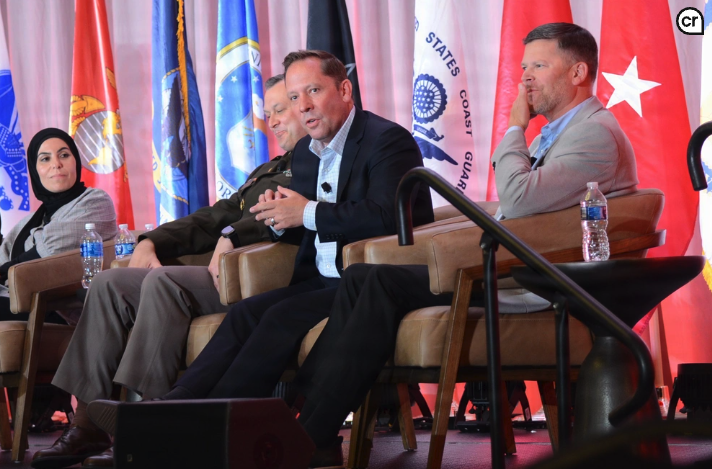
More than 2,500 government, industry and academic leaders gathered in Novi Aug. 11–13 for a symposium focused on bringing artificial intelligence and autonomous vehicles into the U.S. Army's ground fleet.
The 18th annual Ground Vehicle Systems Engineering and Technology Symposium, known as GVSETS, drew Army brass, defense contractors and university researchers to discuss how Michigan's automotive expertise can accelerate military modernization, according to a U.S. Army DEVCOM release.
GVSETS chairman Thom Green, a retired Army colonel with 33 years of service, told Military Embedded Systems that Michigan sits at the center of the Army's ground-vehicle supply chain. The state has 5,000 defense industry partners and $31 billion in contracts flowing through it, Green said.
"There's no other place in the country with this density of ground-vehicle talent and infrastructure," Green said.
The Army's Tank Automotive and Armaments Command and its Ground Vehicle Systems Center, both based in Warren, manage roughly 60 percent of the Army's equipment, MLive reported in July.
Eric Patton, GVSETS deputy chair and president of Ares Technology, said AI is reshaping how the military builds and operates vehicles. The stakes are high. He described AI and autonomy as "transformational across the board," noting that AI is changing target detection and enabling autonomous operations.
Patton said Brigadier General Beth A. Behn, commanding general of U.S. Army TACOM, spoke at the symposium about using AI to reduce the cognitive burden on soldiers and better sustain equipment.
General Dynamics Land Systems announced at the event a plan to adopt a model-year format for vehicle upgrades, borrowing the auto industry's approach of incremental annual improvements. That strategy relies on a modular open systems approach, or MOSA, which Patton said helps prevent vendor lock-in and keeps upgrade costs down.
The Army is also working with General Motors and Ford to leverage their truck-making capability, Patton said. In a conflict, the military could lean on automakers to produce vehicles at scale.
Patton pointed to autonomy as the biggest potential game-changer, citing "tremendous gains in ground autonomy in the last five years." The next frontier, he said, involves multiple unmanned systems working together across ground and air.
A pitch competition hosted by Velocity, a Macomb County innovation hub, offered up to $25,000 for emerging defense-tech startups during the symposium. Camp Grayling in northern Michigan, which covers 147,000 acres, also figured in discussions as a testing ground where companies can experiment across ground, air and water in a single space. No date for the 2027 symposium has been announced.